
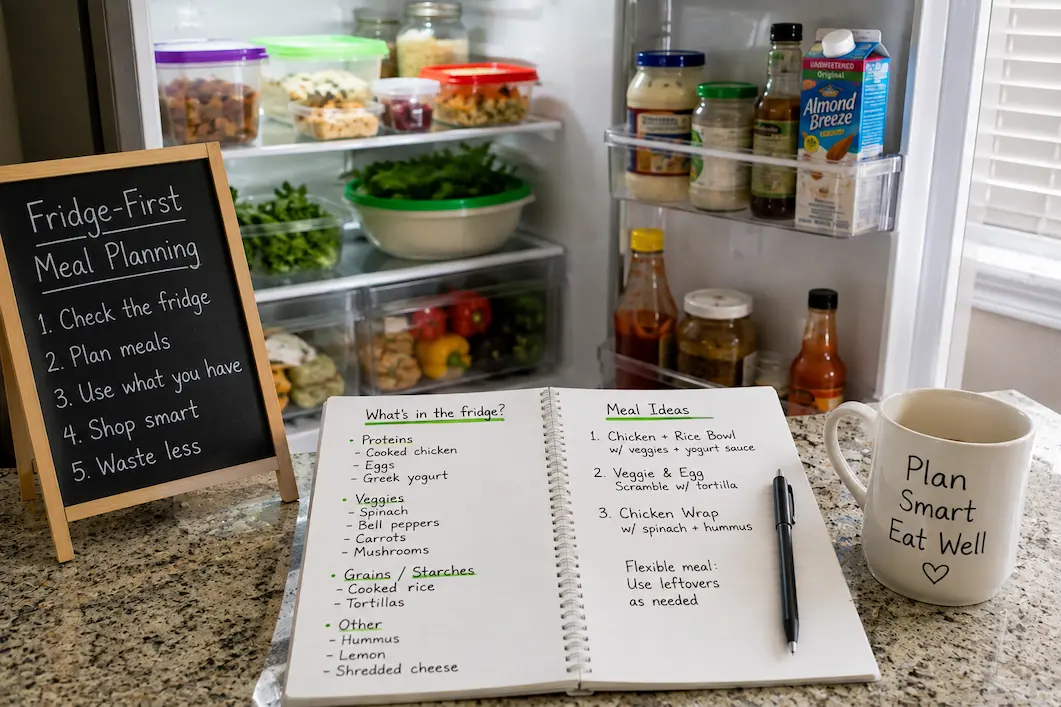
Meal planning often starts in the wrong place. People open a recipe app, choose five dinners, write down a long grocery list, and only afterward remember that there are already vegetables in the crisper drawer, half a container of cooked rice on the middle shelf, and several ingredients that need to be used soon.
A fridge-first approach reverses that process. Instead of deciding what to buy and then figuring out what to do with the food already at home, you begin by looking at what needs attention. You build a few meals around those ingredients, check the pantry and freezer for supporting foods, and only then buy what is genuinely missing. It sounds like a small change, but it can make a busy week considerably easier.
This method is not about eating random leftovers for five nights or making every meal from scratch. It is a way to make your existing food part of the plan before buying more. The result can be less food waste, fewer unnecessary grocery purchases, and a meal plan that feels more realistic because it starts with the kitchen you actually have.
What “Fridge-First” Really Means
A fridge-first meal plan begins with an inventory rather than a recipe.
That does not mean taking every item out of the refrigerator and creating a detailed spreadsheet. A quick scan is enough. Seek food that is already cooked, produce that is becoming ripe, opened dairy products, fresh herbs, packages that have been started, and ingredients that are unlikely to stay at their best for another week.
Then ask a more useful question than “What recipe can I make with these items?”
Ask:
“Which foods need to be used first, and what meals could naturally include them?”
That distinction matters. If you have a lot of spinach to use, the answer doesn’t have to be a “spinach recipe.” It could become part of eggs, a pasta dish, a grain bowl, a soup, a sandwich, or a side dish. One ingredient can support several meals when you think in terms of components rather than fixed recipes.
The method works particularly well for busy households because it gives you a starting point without forcing you to decide the entire week at once.
Start with a Five-Minute Refrigerator Check
Before planning anything, open the refrigerator and identify three groups: use first, use soon, and can wait.
“Use first” includes food that is already cooked, produce that is becoming very ripe, opened items with a limited remaining shelf life, and anything you know you will not want sitting there much longer. “Use soon” includes foods that are still in good condition but should probably become part of the next few meals. Everything else can remain available for later in the week.
You do not need to assign exact expiration dates to every item. The point is simply to create a rough order of priority.
A quick note on your phone can be enough:
| Priority | What might belong here | Planning idea |
|---|---|---|
| Use first | Cooked vegetables, ripe fruit, opened fresh foods | First 1–2 meals |
| Use soon | Fresh produce, dairy, opened packages | Middle of the week |
| Can wait | Eggs, longer-lasting vegetables, condiments | Flexible |
| Already cooked | Rice, chicken, beans, roasted vegetables | Reuse as meal components |
| Freezer | Frozen vegetables, meat, bread | Backup meals |
This five-minute check prevents a common planning mistake: buying fresh ingredients for the week while older fresh ingredients remain untouched.
Don’t Plan Seven Completely Different Meals
A busy week becomes much harder when every dinner requires a different recipe, different ingredients, and a separate preparation process.
Instead, look for overlap.
Suppose you have bell peppers, cooked chicken, yogurt, spinach, and rice. You do not need five recipes that happen to contain those ingredients. You could prepare or use the ingredients in different combinations: chicken and rice bowls, stuffed peppers, a wrap with chicken and yogurt sauce, or eggs with sautéed peppers and spinach.
The meals do not have to taste identical.
This is where flexible ingredients become valuable. A batch of roasted vegetables can be a side dish one night, part of a grain bowl another night, and an omelet filling later. Cooked chicken can become a dinner component, sandwich filling, salad topping, or soup ingredient.
The objective is not repetition for its own sake. It is preparing ingredients that can move between meals without feeling like you are eating the same plate every day.
Build the week around the foods that need attention
Once you know what needs using, choose your first meal around the most urgent ingredients.
For example, if fresh mushrooms and spinach are already beginning to look tired, they should influence the first couple of meals. If you have ripe tomatoes and fresh herbs, use those before the sturdier vegetables that can comfortably wait.
This changes the usual meal-planning hierarchy.
Instead of:
Recipe → ingredients → grocery shopping
you are working with:
Existing food → possible meals → missing ingredients → grocery shopping
That is the heart of the fridge-first method.
It also prevents the grocery list from becoming unnecessarily large. If a recipe calls for three vegetables and you already have two that could reasonably work in the same type of dish, there may be no reason to buy all three.
Use the Pantry and Freezer as Supporting Players
The refrigerator should come first, but it should not work alone.
Pantry and freezer foods are useful because they can turn a few refrigerator ingredients into complete meals. Canned beans, lentils, tomatoes, pasta, rice, oats, tortillas, spices, frozen vegetables, frozen fruit, and other staples can fill gaps without requiring another trip to the store.
For example, half a container of cooked vegetables may not look like dinner. Add pasta and a simple sauce, and it becomes a meal. A few vegetables can become a filling for eggs or tortillas. Leftover chicken can become useful once you have rice, bread, or beans available.
This is one reason it helps to keep a modest collection of reliable staples rather than purchasing every ingredient separately for every recipe.
You are essentially creating a bridge between what needs using and what you want to eat.
Plan Meals by Order of Perishability
Not every meal has to be assigned to a specific day, but perishability should influence the order.
Fresh leafy greens and very ripe produce usually deserve attention earlier than foods that keep well. Meals containing those ingredients can be placed toward the beginning of the week, while meals built around sturdier ingredients can be left for later.
A simple sequence might look like this:
- Early week: use the most delicate fresh ingredients.
- Middle of the week: use cooked leftovers, opened products, and produce that remains in good condition.
- Later week: rely more heavily on sturdier vegetables, pantry staples, freezer foods, or ingredients intentionally saved for later.
This is more flexible than writing “Monday = recipe A, Tuesday = recipe B” and then feeling as though the plan has failed if Tuesday gets unexpectedly busy.
If plans change, move the meals around while keeping the perishability order in mind.
Leave One Meal Unplanned
This is one of the most useful parts of the method.
Do not assume that every meal needs to be scheduled several days in advance. Leave at least one meal flexible, particularly if your week tends to change. That meal might become a leftovers night, a freezer meal, a quick egg dinner, a sandwich, or an improvised combination of whatever remains.
Leaving space also prevents overbuying. If you have planned seven entirely different meals, you have probably committed yourself to purchasing enough ingredients for seven separate ideas. If one meal is intentionally flexible, you have room to use unexpected leftovers instead. A flexible meal is not a sign of poor planning. It is part of effective planning.
Think in Components, Not Complete Recipes
One of the biggest improvements you can make is changing the unit you plan.
A complete recipe might say:
Chicken with roasted vegetables and rice.
A component-based plan thinks:
- cooked chicken
- roasted vegetables
- cooked grain
- yogurt-based sauce
Those four components can be combined in several ways.
The chicken might go into a wrap. The vegetables can accompany eggs. The rice can become a bowl with beans and the remaining sauce. The yogurt mixture can be used as a dip or dressing. This approach is particularly helpful when cooking for people with different preferences. One person can assemble a bowl while another makes a wrap using many of the same prepared ingredients.
You are doing some work once, but preserving several choices afterward.
Grocery Shopping Becomes Much Shorter
Only after looking through the refrigerator, pantry, and freezer should you make the shopping list.
At that point, separate your list into essential and optional items.
Essential ingredients are foods needed to turn what you already have into actual meals. Optional ingredients are things that would be helpful but are not necessary. For example, if you have chicken, rice, peppers, and yogurt, you might only need lemons and herbs to make several meals more interesting. You do not necessarily need another collection of vegetables, sauces, grains, and toppings simply because a recipe happens to include them.
This is where the fridge-first approach can save money without requiring an extremely restrictive grocery budget. You are purchasing with a specific purpose instead of shopping first and finding a purpose later.
What If the Refrigerator Looks Completely Random?
This is where the method becomes most useful.
You might have half a cucumber, two carrots, some cooked rice, a small amount of chicken, a nearly finished container of yogurt, and a few eggs. None of those foods necessarily looks like a recipe.
But they can still form the basis of meals.
The cucumber and yogurt can become a sauce or salad component. The carrots can be roasted or sautéed. The rice can form the base of a bowl. The chicken can be added to it, while eggs provide another meal option.
The goal is not to use every ingredient together. That often creates strange meals and can make the process feel like punishment for having leftovers. Instead, group ingredients that naturally belong together and give the remaining ingredients another job. That small distinction makes improvisational cooking much easier.
A Practical Example of the Method
Imagine you open your refrigerator on Sunday and find:
- cooked rice from Saturday
- half a package of cooked chicken
- spinach
- carrots
- bell peppers
- Greek yogurt
- eggs
- a few tortillas
Rather than searching for seven recipes, you could build a loose plan.
- First meal: use the spinach and peppers with eggs and tortillas.
- Second meal: use chicken, rice, carrots, and a yogurt-based sauce in bowls.
- Third meal: use remaining chicken and vegetables in wraps.
- Flexible meal: use whatever remains with eggs, rice, or another pantry staple.
You may still need a few ingredients, depending on what is in your pantry. But the starting point came from the refrigerator rather than from a recipe collection.
That is the difference.
Don’t Confuse “Fridge-First” with “Use Everything Immediately”
There is a temptation to take the idea too far.
If you have a fresh container of yogurt that will comfortably last several more days, there is no need to force it into tonight’s dinner just because it is already open. Likewise, a sturdy vegetable does not necessarily need to be used before a more perishable food simply because it happens to be visible.
The method is about prioritizing, not panic.
Food quality and safety still matter. Follow the storage instructions for individual foods, keep refrigerated foods properly chilled, and use your judgment when something shows signs of spoilage. A meal plan should reduce waste, not encourage someone to eat food that is no longer safe.
A Simple Weekly Framework
If you like having some structure, this version is easy to repeat:
| Step | Question to ask |
|---|---|
| 1. Look | What is already in the refrigerator? |
| 2. Prioritize | What needs attention first? |
| 3. Group | Which ingredients naturally work together? |
| 4. Build | What 3–4 meals could use them? |
| 5. Check | What pantry or freezer foods can fill the gaps? |
| 6. Shop | What do I really need to buy? |
| 7. Leave room | What meal can stay flexible? |
The entire process can take less time than browsing recipes without a plan.
When the Method Doesn’t Work Perfectly
There will be weeks when the refrigerator does not contain enough food to build a sensible plan. There may be weeks when you are traveling, working unusual hours, attending events, or simply not in the mood to cook.
That does not mean the method has failed.
A fridge-first plan is a framework, not a rule that every meal must be made from leftovers. If you need to buy a ready-made meal, order food, or cook something completely unrelated to what is already in the refrigerator, do it.
The benefit comes from using the method when it is useful—not from turning it into another obligation.
The Real Advantage is Flexibility
The best meal plan is usually not the one with the most recipes. It is the one that still works when the week stops behaving as expected.
A fridge-first system gives you that flexibility because the meals are based partly on ingredients and components rather than a rigid seven-day schedule. If Wednesday becomes unexpectedly busy, you can move a more involved meal to Thursday. If you have more leftovers than expected, the flexible meal can absorb them. If an ingredient needs using sooner than anticipated, it can move forward.
You are planning the ingredients and possibilities, not trying to predict every meal perfectly.
That makes the system particularly useful for busy weeks when time, appetite, and schedules can change from one day to the next.
Conclusion
Fridge-first meal planning is a simple reversal of the way many people approach weekly cooking. Instead of choosing recipes first and shopping for everything afterward, start with the food already in your kitchen.
Identify what needs using, build a few flexible meals around those ingredients, use pantry and freezer staples to fill the gaps, and buy only what is genuinely missing. Leave some space in your schedule so that leftovers and unexpected changes have a place to go.
You do not need a perfect meal plan, an elaborate meal-prep routine, or a refrigerator full of specially purchased ingredients. A five-minute look inside the fridge can often tell you more about what you should cook next than another hour spent scrolling through recipes.
Frequently Asked Questions
How far ahead should I use the fridge-first method?
A full week can work, but you do not have to plan every meal seven days ahead. Many people will find it easier to make a loose plan for several days and leave one or two meals flexible. This allows the plan to change as ingredients are used and schedules shift.
Should I use everything in my refrigerator before grocery shopping?
No. The purpose is to prioritize food that needs attention, not to empty the refrigerator. Some ingredients may still have plenty of useful storage time. Use the foods that are most perishable first and keep appropriate foods for later.
Can fridge-first meal planning work for a family?
Yes, and the component approach can make it particularly useful for families. Preparing ingredients such as cooked vegetables, grains, chicken, beans, sauces, and toppings separately allows people to assemble meals according to their preferences without requiring entirely different dinners.
What should I do if I have ingredients that don’t seem to go together?
Don’t force them into one dish. Separate the ingredients into small groups that make culinary sense and use each group differently. A random collection of foods can often become two or three simple meals rather than one complicated combination.
How do I stop the same leftovers from appearing every night?
Prepare versatile components rather than one large finished dish whenever practical. For example, cooked chicken, roasted vegetables, rice, and a sauce can become bowls, wraps, salads, or another meal instead of being served in the same combination each time. Changing the format and seasonings can make the same basic ingredients feel substantially different.

Olivia Dawson is a food writer and recipe developer focused on creating clear, practical, and family-friendly cooking content. She specializes in approachable recipes made with everyday ingredients and well-explained methods that support confident cooking. Through Recipes With Olivia, Olivia shares thoughtfully crafted meal ideas designed to be reliable, enjoyable, and easy to recreate in everyday kitchens.