
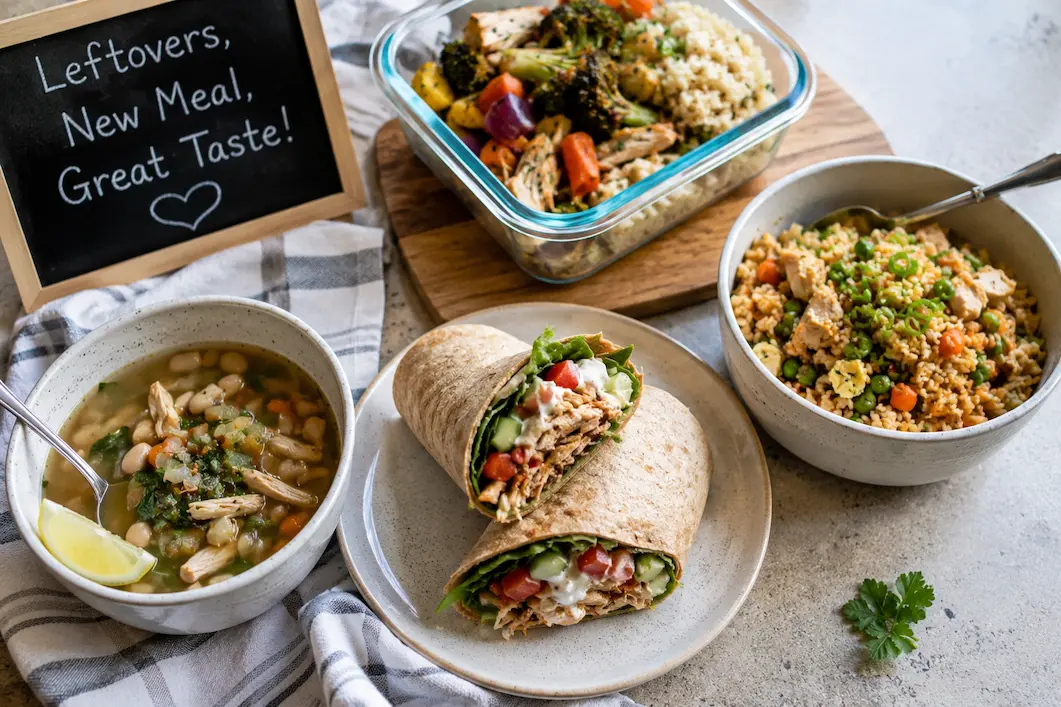
Leftovers have a bad reputation as the meal you eat out of obligation, not desire. Sometimes that reputation is deserved. A container of yesterday’s rice, chicken, and vegetables can feel unique after another night in the refrigerator, especially when it is reheated and served in exactly the same way. But the problem is often not the food itself. It is the fact that nothing about the second meal has changed.
A leftover does not have to remain a leftover in the traditional sense. Cooked chicken can become the filling for a warm wrap, rice can become the base of an entirely different bowl, and roasted vegetables can be folded into eggs or turned into a quick soup. You are not necessarily trying to recreate the original meal. You are using what is already cooked as a starting point for something with a different flavor, texture, or format.
The easiest way to make this work is to stop asking, “How do I reheat this?” and start asking, “What could this become?” That small change in thinking opens up far more possibilities without requiring another full cooking session.
Start By Identifying What You Actually Have
Before opening the refrigerator and reaching for another recipe, look at the leftovers as individual components. A container labeled “Tuesday’s dinner” may hold several ingredients that you can separate and use in completely different ways. The chicken might work in a sandwich, the vegetables could become part of an omelet, and the rice could form the base of a new bowl.
This is particularly useful when you have several small leftovers rather than one complete meal. Instead of trying to eat each container exactly as it was originally served, look for ingredients that can be combined differently. A little cooked meat, half an avocado, some roasted vegetables, and a portion of rice may not seem like much individually, but together they can become a satisfying meal with a fresh sauce and a few toppings.
Take a quick inventory before deciding what to make. Separate the foods into broad groups such as protein, grains or starches, vegetables, sauces, and toppings. Once you see the components rather than the original dinner, it becomes much easier to imagine another use for them.
Change The Format First
One of the quickest ways to make leftovers feel different is to serve them in an entirely different format.
A plate of roasted chicken, potatoes, and vegetables can feel like the same dinner when reheated on another plate. Put the chicken into a wrap with fresh vegetables and a yogurt-based sauce, and it becomes a different kind of meal. Turn the potatoes into a breakfast-style hash, or combine the vegetables with eggs. The original cooking has already been done; the transformation comes from how you assemble everything.
This approach is especially useful on busy days because you are not starting from raw ingredients. The leftover food has already taken care of much of the cooking time. You are simply changing the shape and supporting ingredients around it. A bowl can become a wrap, a side dish can become a filling, and yesterday’s dinner can become part of today’s lunch without requiring another complicated recipe.
If a leftover feels boring, changing the format is often more effective than simply adding more seasoning.
Give Rice A Completely Different Personality
Cooked rice is one of the most flexible leftovers because it can support very different flavor combinations.
Plain rice can become the base of a bowl with fresh vegetables, cooked protein, herbs, and a new dressing. It can be sautéed with vegetables and eggs for a quick meal. It can also be paired with beans, salsa, avocado, or other toppings that were not part of the original dinner.
The important part is not to keep every original component together. If the rice was served with grilled chicken and steamed vegetables last night, there is no reason today’s meal needs to repeat that combination. Use the rice as the neutral base and introduce different flavors around it.
Even a simple finishing ingredient can change the experience. Lemon or lime juice, fresh herbs, a flavorful sauce, toasted seeds, or something crisp can make reheated rice feel much less like reheated rice.
Turn Cooked Chicken Into Something You Would Actually Choose
Chicken leftovers are easy to misuse. Reheating the same pieces with the same sides can produce a meal that feels repetitive even when the chicken itself is perfectly fine.
Shredding or slicing the chicken gives you more options. It can become a sandwich filling, wrap ingredient, grain-bowl topping, salad component, soup addition, or filling for another dish. The goal is to change enough of the meal that your brain no longer registers it as yesterday’s dinner.
A new sauce can also make a noticeable difference. A lemony yogurt sauce, mustard-based dressing, salsa, herb mixture, or another flavorful accompaniment can give cooked chicken a new direction. You do not need to cover the chicken in a heavy sauce; a small amount of something well-seasoned can be enough.
If the chicken has become a little dry, focus on adding moisture through the new preparation rather than simply reheating it for longer. A wrap, soup, grain bowl, or sauced dish can often be more forgiving than serving the chicken on its own.
Roasted Vegetables Can Become More Than A Side Dish
Roasted vegetables are particularly useful leftovers because they can be moved into entirely different parts of a meal.
You can fold them into eggs, add them to a grain bowl, combine them with beans, toss them through pasta, or use them as a filling for a wrap. Their original role as a side dish no longer matters once they are combined with other ingredients. Texture can also help. If the vegetables have softened after refrigeration, adding something fresh or crisp can create contrast. Cucumber, cabbage, herbs, toasted seeds, or another crunchy ingredient can make the meal feel more deliberate.
This is a useful principle for almost any leftover: if the original texture has changed, introduce a contrasting texture rather than trying to make the food exactly as it was yesterday.
A Fresh Sauce Can Do More Than Extra Seasoning
Sometimes leftovers taste familiar because the same seasoning profile is still present. A different sauce can change that without requiring you to cook another main ingredient.
Greek yogurt can become the base for a quick herb or lemon sauce. Tahini can provide a nutty, creamy element. A simple vinaigrette can brighten cooked grains and vegetables. Salsa can bring acidity, freshness, and heat. Mustard, lemon juice, herbs, and a little water can also create a quick dressing for various leftovers.
The sauce does not need to be complicated.
In fact, a simple sauce is often better when the leftovers already have strong flavors. You are adding a new direction instead of creating a completely new recipe. Taste the food first, then decide what is missing. If everything feels heavy, something acidic may help. If it is dry, moisture matters more. If the flavors are mild, herbs, spices, or a more assertive sauce may be useful.
Add Something Fresh To Food That Has Been Reheated
Reheated food can sometimes feel dull because everything on the plate has the same warm, soft quality.
Adding one fresh component can immediately create contrast. Chopped cucumber, tomatoes, herbs, shredded cabbage, green onions, fresh fruit, or a squeeze of citrus can bring a different quality to the meal. This does not mean you need to prepare another elaborate side dish. Even a small handful of fresh ingredients can change the balance.
Imagine reheated chicken and rice with a spoonful of yogurt sauce, chopped cucumber, herbs, and lemon. The cooked components are still leftovers, but the fresh additions give the meal a different identity. That is often enough to make it feel like you made something new.
Crunch Is An Underrated Leftover Fix
Texture can matter just as much as flavor.
If a leftover meal consists mostly of soft ingredients, adding something crunchy can make each bite more interesting. Toasted nuts, seeds, roasted chickpeas, fresh cabbage, cucumber, crispy onions, or another suitable topping can provide the contrast that reheated food often lacks.
You do not need a large amount. A small topping can change how the entire meal feels. This is particularly helpful with grain bowls, soups, salads, cooked vegetables, and soft proteins.
The broader lesson is useful when you are improvising: do not only ask what flavor is missing; ask what texture is missing.
Turn Leftover Vegetables Into Breakfast
Leftovers do not have to wait until lunch or dinner.
Cooked vegetables can be surprisingly useful in breakfast dishes. Roasted peppers, onions, potatoes, spinach, mushrooms, zucchini, broccoli, or similar vegetables can be combined with eggs or another breakfast base.
A vegetable-heavy omelet, scramble, breakfast bowl, or warm wrap can use a small amount of several leftovers at once. This is particularly useful when individual containers are too small to become complete meals on their own. Breakfast also gives the leftovers an entirely different context. Food that felt like yesterday’s dinner can seem much less repetitive when it appears alongside eggs, toast, fruit, or another breakfast component.
You are not wasting the food simply because it has crossed from one meal period into another.
Soup Is A Great Way To Combine Small Leftovers
A few tablespoons of cooked vegetables, some leftover chicken, half a container of beans, and a little cooked grain may not be enough to serve separately. They can, however, become useful ingredients in a soup.
Soup is forgiving because ingredients do not have to be identical in shape or quantity. You can combine compatible leftovers with broth, seasonings, herbs, and other ingredients to create a meal that does not resemble the individual dishes from which it came. This can be especially helpful near the end of the week when the refrigerator contains several small portions.
The important thing is to consider compatibility rather than simply throwing everything together. Ingredients with similar flavor profiles are easier to combine successfully, and delicate items may be better added near the end so they do not become excessively soft.
Make A Leftover Wrap When You Need Something Fast
A wrap or flatbread can turn several unrelated leftovers into one coherent meal.
Start with a suitable base, add a protein if you have one, include vegetables, and then use a sauce or spread to connect everything. Fresh ingredients can provide contrast if the cooked leftovers are soft.
This works particularly well with chicken, turkey, beans, roasted vegetables, cooked grains, eggs, and similar ingredients. The beauty of the wrap is that the original portions do not have to be large. A small amount of several leftovers can become a complete lunch when combined thoughtfully.
It also gives you an easy way to change the meal’s identity without spending another hour in the kitchen.
Use A Different Flavor Direction
Another reason leftovers become boring is that the same flavor profile keeps following them around.
If yesterday’s meal was seasoned with herbs and garlic, consider taking the remaining ingredients in a different direction. Add a spicy sauce, a tangy dressing, fresh herbs, citrus, or another seasoning combination that changes the overall impression. You do not need to turn the food into an authentic dish from another cuisine. The point is simply to create contrast with the previous meal.
Think in terms of flavor families: fresh and lemony, smoky and savory, spicy and tangy, herby and creamy, or sweet and savory. Choosing a different direction can make familiar ingredients feel surprisingly different.
Don’t Overheat Everything Together
Reheating technique can also affect whether leftovers taste appealing.
Some ingredients become much softer when heated repeatedly, while others can dry out. If everything goes into the same container and gets heated for the same amount of time, you may lose whatever texture the original meal had.
When practical, separate components before reheating. A sauce may be better added afterward. Fresh vegetables should usually stay fresh. A crunchy topping should be added at the end rather than heated with everything else.
The goal is not merely to make the food hot. It is to bring each component back into a condition where it works well in the new meal.
Cold Leftovers Can Sometimes Work Better
Not every leftover needs to be reheated.
Cooked chicken can work in a cold salad or wrap. Roasted vegetables can be served at room temperature with grains and a dressing. Cooked potatoes can become part of a chilled salad. Some cooked grains can form the base of a cold bowl with fresh vegetables and herbs.
This can be particularly useful during warmer weather or when you want lunch without turning on the stove. Sometimes the easiest way to make a leftover feel new is simply to stop treating it like something that must be reheated.
Combine Two Small Leftovers Instead Of Forcing One To Stand Alone
A single leftover container may not contain enough food for a complete meal.
That does not mean it is useless.
Look for two or three small portions that complement one another. A little cooked chicken can be combined with leftover rice. Roasted vegetables can join beans. A small amount of pasta can become part of a larger vegetable-heavy bowl.
This approach prevents the common habit of eating one tiny container simply because it is there and then still being hungry afterward. The objective is to create a satisfying meal from what is available, not to preserve the original serving sizes exactly.
Use Leftovers As Ingredients, Not Finished Meals
This may be the most useful mindset shift of all.
When you see leftover chicken, do not automatically see “leftover chicken dinner.” See cooked protein that can be added somewhere else. When you see roasted vegetables, see a prepared ingredient that can go into eggs, pasta, wraps, bowls, or soup.
The same applies to grains, beans, sauces, potatoes, and other cooked foods.
Once you stop assigning leftovers to their original recipes, your options expand considerably. You also become less dependent on finding a recipe that happens to match every container in your refrigerator. You already have most of the cooking done. What you need is a new combination.
A Simple Leftover Transformation Formula
When you have no idea what to make, use this loose formula rather than searching for another recipe.
- Choose one base: rice, potatoes, pasta, bread, tortillas, or another suitable ingredient.
- Add one protein: chicken, beans, eggs, lentils, fish, tofu, or whatever is available.
- Add vegetables: cooked, fresh, or a mixture of both.
- Change the flavor: sauce, dressing, herbs, spices, citrus, salsa, or another finishing ingredient.
- Add contrast: something crunchy, fresh, creamy, or acidic.
You do not need every category.
The formula is simply a way to notice what the leftover meal might be missing. If the food already has plenty of vegetables, you do not need to add more just because a formula says so. If the meal is already rich, focus on freshness or acidity instead.
Think of it as a troubleshooting tool, not a recipe.
Know When A Leftover Should Not Be Reused
Making leftovers taste better should never mean ignoring food safety.
Food that has been stored improperly, shows clear signs of spoilage, or has an unusual odor or appearance should not be transformed simply to avoid throwing it away. A new sauce can change the flavor, but it cannot make unsafe food safe.
Store cooked foods appropriately and use them within recommended storage periods. When you are uncertain about a specific food, use reliable food-safety guidance rather than relying on smell or appearance alone.
The goal of leftover cooking is to prevent good food from becoming boring or forgotten—not to find creative uses for food that should no longer be eaten.
The Best Leftover Meals Often Use Very Little Extra Cooking
You do not need to prepare an entirely new dinner to make yesterday’s food more appealing.
Sometimes the transformation takes five minutes: chop a few fresh vegetables, make a quick sauce, warm the existing protein, and assemble everything in a wrap or bowl. Another meal might only require reheating rice, adding beans, and finishing it with herbs and a squeeze of citrus.
This is where leftovers become especially useful during busy weeks. Instead of viewing the refrigerator as a collection of meals that must be repeated, view it as a collection of ingredients that have already had their most time-consuming preparation completed. That is a much more useful way to cook.
Final Takeaway
Good leftovers don’t have to taste like leftovers.
The simplest way to change them is to change something meaningful about the meal: the format, the seasoning, the sauce, the temperature, the texture, or the ingredients surrounding the original food. Rice can become a bowl, chicken can become a wrap, vegetables can become breakfast, and several small portions can become soup.
You also do not need a refrigerator full of special ingredients. A few fresh vegetables, herbs, citrus, sauces, crunchy toppings, or other versatile additions can give familiar cooked foods an entirely different direction.
Most importantly, stop thinking of leftovers as finished meals that have already been used. Think of them as prepared ingredients waiting for another combination.
That mindset saves cooking time, reduces unnecessary food waste, and makes it much easier to build a satisfying meal from what is already in the kitchen.
Frequently Asked Questions
How Do I Make Leftovers Taste Less Repetitive?
Change more than just the temperature. Use a different sauce, add fresh ingredients, introduce a crunchy topping, or serve the food in a different format. Turning a plate into a wrap, bowl, salad, or breakfast dish can make the same cooked ingredients feel substantially different.
What Is The Easiest Way To Transform Leftover Chicken?
Slice or shred it and use it in a wrap, sandwich, salad, soup, or grain bowl. A new sauce or dressing can also change the flavor considerably. If the chicken is dry, combine it with something moist rather than repeatedly reheating it.
How Can I Make Leftover Rice More Interesting?
Use it as a base for a new combination. Add vegetables, beans, eggs, cooked protein, fresh herbs, salsa, citrus, or a different dressing. You can also sauté the rice with suitable ingredients rather than simply reheating it.
Can I Combine Different Leftovers In One Meal?
Yes, provided the ingredients work together in terms of flavor and texture. Combining several small portions can be a good way to avoid wasting food. A little chicken, rice, vegetables, and beans can become a bowl or wrap instead of four separate containers.
How Do I Make Leftovers Taste Fresh?
Add something that has not been refrigerated and reheated. Fresh herbs, cucumber, tomatoes, shredded cabbage, green onions, citrus juice, or a fresh sauce can provide brightness and texture that reheated food may lack.
Why Do My Leftovers Taste Dry After Reheating?
Repeated heating can cause some foods, particularly certain meats and starches, to lose moisture. Try adding a suitable sauce, dressing, broth, or other moist component. Reheating only as much as you need can also help prevent unnecessary additional cooking.

Olivia Dawson is a food writer and recipe developer focused on creating clear, practical, and family-friendly cooking content. She specializes in approachable recipes made with everyday ingredients and well-explained methods that support confident cooking. Through Recipes With Olivia, Olivia shares thoughtfully crafted meal ideas designed to be reliable, enjoyable, and easy to recreate in everyday kitchens.