
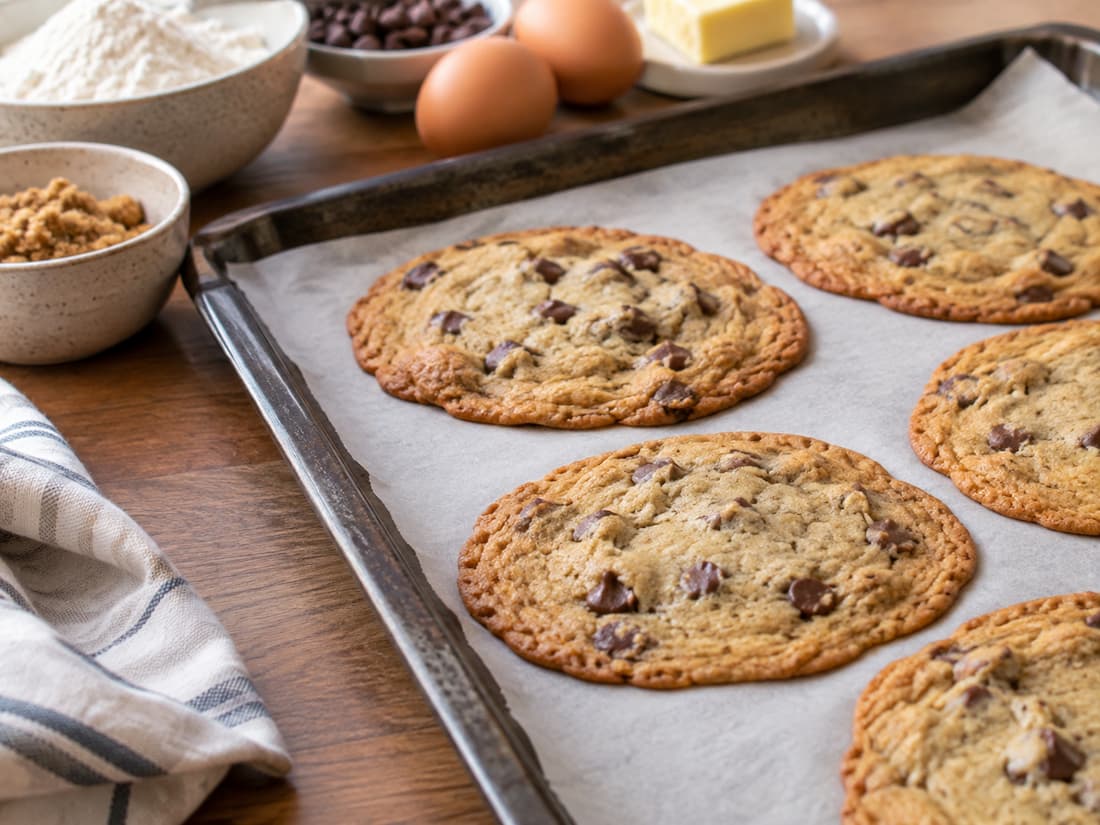
A cookie that spreads too far can be frustrating. Instead of staying thick with a defined shape, the dough may melt outward, producing thin cookies with crisp edges, a greasy surface, or centres that never develop the texture you expected. The important thing is that excessive spreading usually has a reason. Cookies are not supposed to hold their shape from the moment they enter the oven. Butter melts, sugar dissolves, moisture turns to steam, and the dough gradually sets. The final shape depends on which of those changes happens first and how quickly they occur.
That is why simply adding more flour is not always the right fix. The problem may come from warm butter, too much sugar, a different flour measurement, an overly warm baking sheet, oven temperature, or dough that has been left sitting before baking. Understanding what happens during those first few minutes in the oven makes the problem much easier to solve.
What Happens When Cookie Dough Bakes
Most cookie dough contains some combination of fat, sugar, flour, eggs, and a leavening ingredient. When the dough enters the oven, the fat softens and melts. Sugar changes as it warms, moisture begins to evaporate, and the flour absorbs moisture while the proteins and starches gradually help the cookie become firm. There is a short period when the dough is soft enough to move but has not yet fully set. If the fat melts and the dough loses its structure before the flour and egg proteins have firmed up, the cookie can spread substantially. If the dough sets earlier, it retains more of its original shape. In simple terms, cookie spread is a balance between melting and setting. A small change in ingredients or preparation can shift that balance.
Butter That Is Too Warm Is a Common Cause
Butter temperature is one of the easiest things to overlook. Many cookie recipes call for softened butter because it needs to combine properly with sugar. But softened does not mean melted, oily, or noticeably warm. Butter that has become extremely soft can behave differently from butter that is merely pliable. If the butter is already warm when the dough is mixed, the finished dough may also be warmer. Once it reaches the oven, the fat can melt quickly, allowing the dough to move outward before enough structure develops. This can happen after butter has been softened in a warm kitchen, left near an oven, or heated too aggressively in a microwave.
What Properly Softened Butter Looks Like
Softened butter should be easy to press with a finger while still holding its shape. It should not look glossy or partially liquid. If the butter has melted and then been mixed into a recipe that specifically expects softened butter, the dough may not behave the same way. Melting changes how the fat interacts with the flour and sugar and changes the structure created during mixing. If your dough seems unusually soft or greasy before baking, temperature is worth checking before changing the ingredient ratios.
Too Little Flour Can Make Cookies Flatten
Flour provides much of the framework that allows a cookie to hold its shape. When there is too little flour relative to the fat and liquid in the dough, the mixture has less structure available to resist spreading. The result can be a cookie that becomes very wide and thin. One common reason is inconsistent flour measurement. Scooping flour directly from a container can produce a different amount than gently filling a measuring cup and levelling it. There is another possibility: the recipe itself may use a relatively low amount of flour intentionally. Some cookies are designed to spread more than others, so adding extra flour simply because a cookie looks thin can change the intended texture. Before adding flour, consider whether the recipe is supposed to produce a thick, soft cookie or a thinner, crispier one.
Why Adding Too Much Flour Can Create a Different Problem
It is tempting to keep adding flour until the dough looks firm. That can reduce spreading, but it may also produce dense, dry, or cakey cookies. Flour does more than control shape; it changes how moisture and fat are distributed through the dough. If you suspect a measurement problem, correcting the measuring method is usually more useful than repeatedly adding flour by eye.
Sugar Has More Influence Than You Might Expect
Sugar does not simply make cookies sweet. It affects spread, browning, moisture, and texture. As sugar warms, it dissolves and contributes to the cookie’s ability to flow while baking. Recipes with relatively high amounts of sugar can therefore produce cookies that spread more readily than doughs with a different sugar balance.
The type of sugar matters too. Granulated sugar and brown sugar contain different amounts of moisture and behave differently in cookie dough. Brown sugar contains molasses, which contributes moisture and flavour. Changing one type of sugar for another can therefore alter the finished cookie even when the total amount appears similar.
This is one reason an apparently simple substitution can produce an unexpected result. If you changed the sugar because you were out of the type called for in the recipe, the Ingredient Swap Decision Tool can help you think through whether a substitution is likely to change the dough’s behaviour before you make the swap.
Eggs Provide Structure, But They Are Not a Simple Fix
Eggs contribute moisture, fat, proteins, and structure to many cookie recipes. As the cookie heats, egg proteins eventually help the dough firm up. But adding an extra egg simply to stop spreading is not a reliable solution because it also adds moisture and changes the overall balance of the dough. The same applies to removing an egg. A cookie that spreads too much should not automatically be blamed on the egg quantity. Instead, check whether the recipe was followed as written and whether substitutions or unusually large eggs changed the amount of liquid going into the dough.
Melted Butter Is Not Automatically Wrong
Some cookie recipes deliberately use melted butter. Melted butter can produce a different texture and spreading pattern, but that does not make it an error. The important question is what the recipe was designed around. A recipe written for melted butter accounts for that state when the other ingredients are balanced. Problems arise when melted butter is substituted into a recipe that expects softened butter without considering the structural changes. Likewise, chilling dough made with melted butter may help control spreading, but it does not necessarily make the dough equivalent to one made with softened butter. The form of the fat is part of the recipe, not merely a preparation detail.
Chilling the Dough Can Help
Refrigerating cookie dough is one of the most common recommendations for excessive spreading, and it can be useful. Cold dough enters the oven with firmer fat. The fat takes longer to melt, giving the flour and other structural ingredients more time to begin setting before the cookie has spread as far. But chilling cannot correct every problem. If the dough contains substantially too much liquid or fat, chilling may reduce the speed of spreading without completely solving it. If flour was measured incorrectly, the underlying imbalance remains. There is also a difference between chilling briefly and refrigerating dough for a much longer period. Very cold dough may need additional time to become workable, and some doughs change in texture as they sit. For a recipe that specifically recommends chilling, follow its instructions rather than assuming that longer chilling will always produce a better cookie.
Your Baking Sheet Can Change the Result
The surface underneath the cookie matters. A dark baking sheet can absorb and transfer heat differently from a light-coloured one. A heavily greased sheet can also provide a more slippery surface, allowing dough to move more easily as the fat melts. If the cookie dough already has a strong tendency to spread, adding extra grease to the pan may make the problem worse. Parchment paper can provide a consistent surface and make cookies easier to remove. A silicone baking mat can behave somewhat differently because its surface and heat transfer characteristics are not identical to parchment or bare metal. The important point is not that one surface is always correct. It is that changing the baking surface can change how the dough behaves.
A Hot Baking Sheet Can Make the Next Batch Spread More
Reusing the same baking sheet for multiple batches is convenient, but the temperature of that sheet matters. If fresh cookie dough is placed directly onto a hot baking sheet, the bottom of the dough begins warming immediately. That can encourage the butter to melt before the cookie has had time to establish its structure.
This is especially noticeable with doughs that already spread easily. If you are baking several batches, allow the baking sheet to cool before placing another batch of dough on it. Using a second sheet can make this easier when the first batch is still in the oven.
Oven Temperature Affects Cookie Shape
A recipe’s stated oven temperature is more than a timing instruction. If the oven is cooler than expected, the dough may remain soft for longer while the butter melts. The cookie can spread before enough structure develops. If the oven is hotter than expected, the outside may set and brown quickly. That changes the timing of melting and setting as well.
Home ovens can also have temperature variation, and the displayed temperature does not always represent the exact temperature at the position where the cookies are baking.
When cookies repeatedly spread much more than expected despite following the recipe, oven temperature is one variable worth considering.
Dough That Sits on the Counter Can Change
Even if the recipe starts with properly prepared ingredients, the dough can become warmer while waiting. This is easy to miss when you are preparing several trays, portioning dough slowly, or working in a warm kitchen. The first tray may bake normally while later portions spread more. That pattern is a useful clue because the ingredients have not changed, but the dough temperature has. If later batches become noticeably flatter, keeping the unbaked dough cooler can help maintain more consistent results.
Leavening Agents Can Influence Cookie Spread
Baking soda and baking powder are not interchangeable. They both affect how dough changes during baking, but they work differently and are used in different recipe balances. Changing the amount or substituting one for another can alter the cookie’s shape, thickness, browning, and texture.
Baking soda can also affect browning and spread in recipes where it is part of a carefully balanced mixture. If a cookie behaves differently after you replace one leavening ingredient with another, the substitution may be responsible rather than the baking temperature. For this reason, avoid changing several ingredients at the same time when troubleshooting. If you alter the flour, butter, sugar, and leavening together, you will not know which change affected the result.
Creaming Butter and Sugar Is About More Than Mixing
Recipes that begin by creaming butter and sugar are using the mixing process to create a particular dough structure. As the butter and sugar are beaten together, the mixture becomes lighter and changes in texture. The process also affects how the other ingredients are incorporated later. Under-mixing can produce a different result from thorough creaming, while excessive mixing after flour is added can affect the dough in another way. This does not mean you need to beat the mixture for an arbitrary number of minutes. Different mixers, butter temperatures, and recipes behave differently. Instead, pay attention to the recipe’s intended texture. If the instructions call for creaming softened butter and sugar until light and cohesive, that step should not be rushed.
Why One Batch Can Spread More Than Another
Sometimes the problem is not the recipe at all. Two trays made from the same dough can behave differently if they were prepared under different conditions.
Consider a batch where the first tray is portioned immediately after mixing while the second tray sits on the counter for twenty minutes. The second batch may be warmer and therefore spread more. Similarly, a cool baking sheet and a recently used hot baking sheet can produce different results.
Even the size of the dough portions matters. Smaller pieces heat through more quickly, while larger portions have more time for the outside to set before the centre becomes fully heated. When troubleshooting, look for patterns rather than judging one cookie in isolation.
A Practical Way to Troubleshoot the Recipe
When a cookie spreads too much, resist the urge to immediately rewrite the recipe.
- Start with the simplest checks.
- First, confirm that the ingredients were measured as written. Then look at the butter: was it softened, melted, or unusually warm? Check whether the dough itself feels very soft or greasy.
- Next, consider the baking sheet. Was it cool when the dough was placed on it? Was it heavily greased? Were later batches baked on a sheet that had just come out of the oven?
- Then consider the oven. If the same dough consistently produces unusually thin cookies, temperature becomes more relevant.
- Finally, look at substitutions. Changes to flour, sugar, butter, eggs, or leavening ingredients can affect the balance more than expected.
Change One Variable at a Time
This approach is one of the most useful habits when solving cookie problems. Suppose you think the dough is too warm. Chill the dough and see whether the result changes. If that helps but does not completely solve the issue, investigate another variable during the next batch. Changing five things at once may produce a different cookie, but you will not know why. A small adjustment is often more useful because it gives you information about what caused the problem.
Should You Add More Flour?
Sometimes a recipe genuinely needs more flour, but this should not be the automatic response.
- If the dough was made according to a reliable recipe and the ingredients were measured correctly, adding flour changes the intended ingredient balance.
- It is more sensible to investigate whether the butter was too warm, the flour was measured differently, the dough was allowed to become warm, or a substitution was made.
- If the recipe itself is poorly balanced, additional flour may eventually be part of the solution, but that is different from correcting a preparation problem.
Adding enough flour to make the raw dough look firm can also be misleading. Cookie dough does not need to resemble bread dough to bake properly.
What If the Cookies Spread Only Slightly?
Not all spreading is a problem. Most cookies expand during baking. A dough ball that looks exactly the same after baking would be unusual for many styles of cookie. The better question is whether the final shape matches the recipe’s intended result. A cookie can spread enough to develop a thinner edge while still retaining a substantial centre. Another recipe may intentionally produce a flatter, crispier cookie. Look at the finished texture as well as the width. If the cookie spreads but still has the expected thickness, browning, and texture, this amount of movement may simply be part of the recipe.
When Ingredient Substitutions Are the Real Problem
Ingredient substitutions are another common source of unexpected cookie spread. Replacing butter with another fat, changing sugar types, using a different flour, altering the egg quantity, or replacing a dairy ingredient can change moisture and structure. If you are trying to diagnose a spreading problem, return to the original ingredient list before making additional substitutions. If you need to make a substitution because an ingredient is unavailable, the Ingredient Swap Decision Tool can help you consider the change before altering the dough. The key point is that a substitution should be treated as a change to the recipe’s balance, not simply as a one-for-one replacement.
What About Leftover Cookie Dough?
If you have extra cookie dough after baking one tray, the way you handle it can affect the next batch. Dough left sitting at room temperature can become softer, particularly in a warm kitchen. Instead of assuming that the recipe suddenly stopped working, compare the later dough with the portion that produced the better cookies.
If you are also trying to use leftover ingredients from another baking project, the Leftover Remix Planner can help with ideas for deciding how to use available leftovers rather than changing the cookie recipe simply to avoid waste. The cookie itself, however, should still be treated as a separate troubleshooting problem. Adding unrelated ingredients just to use them up can change the dough balance.
Final Thoughts
Cookies spread because their structure changes as they heat. Fat melts, sugar changes, moisture moves, and the dough eventually sets. When melting happens faster than the cookie can establish enough structure, the dough can travel farther across the baking sheet.
The most useful approach is to look for the reason rather than automatically adding flour. Check the butter temperature, ingredient measurements, sugar and flour balance, dough temperature, baking sheet, oven conditions, and any substitutions you made.
Once you start treating excessive spreading as a clue rather than simply a failed batch, the shape of the finished cookie becomes much more informative. A flat cookie can tell you a great deal about what happened to the dough before it had a chance to set.
When the Problem Is Actually the Recipe
Sometimes you can follow the instructions carefully and still end up with cookies that spread more than expected. If you have consistently measured the ingredients, used the specified butter preparation, followed the mixing instructions, maintained a consistent dough temperature, and used the stated oven conditions, the recipe itself may be the variable worth questioning.
This is particularly important when a recipe produces the same unexpected result repeatedly. Instead of making several large changes, record what happened and adjust one aspect at a time. That gives you a much clearer understanding of whether the issue is ingredient balance, preparation, or equipment.
FAQs
1. Why Do My Cookies Spread but Still Taste Good?
A cookie can taste perfectly good while having a different shape or texture from what you expected. If the flavour is fine but the cookies are thinner than intended, check dough temperature, butter consistency, flour measurement, baking-sheet temperature, and oven conditions before changing the recipe.
2. Can I Refrigerate Cookie Dough That Spreads Too Much?
Often, yes. Cooling firms the fat and can slow spreading during the early part of baking. However, refrigeration does not resolve every underlying problem, particularly if the dough contains an incorrect ingredient ratio.
3. Should I Put Cookie Dough on a Hot Baking Sheet?
It is generally better to place fresh dough on a cool baking sheet when excessive spreading is already a concern. A hot sheet begins heating the bottom of the dough immediately and can encourage the fat to melt quickly.
4. Does More Flour Always Make Cookies Thicker?
No. More flour can increase structure, but too much can produce cookies that are dense or dry and can change the intended texture. Check measurement, butter temperature, and other ingredients before adding extra flour.
5. Why Did My Second Tray of Cookies Spread More?
The dough may have become warmer while waiting, or the second tray may have been placed on a warm baking sheet. Comparing the conditions of the first and second batches can help identify the difference.

Olivia Dawson is a food writer and recipe developer focused on creating clear, practical, and family-friendly cooking content. She specializes in approachable recipes made with everyday ingredients and well-explained methods that support confident cooking. Through Recipes With Olivia, Olivia shares thoughtfully crafted meal ideas designed to be reliable, enjoyable, and easy to recreate in everyday kitchens.