
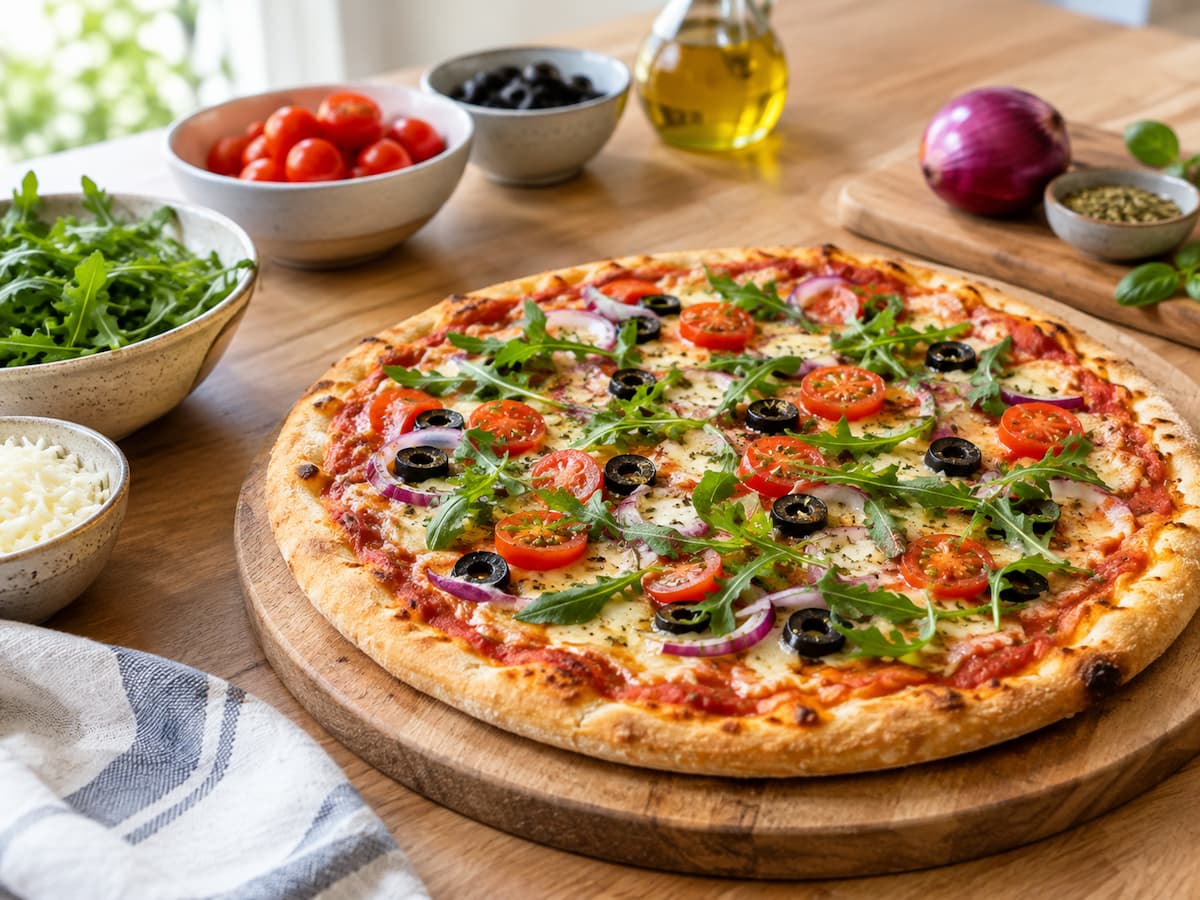
Homemade pizza gives you control over the crust, sauce, cheese, and toppings. That control makes it easier to create a pizza that feels satisfying without becoming heavy, greasy, or difficult to slice. The key is not simply using less of everything. It is choosing the right proportions and preparing each ingredient so that the crust can bake properly.
A thin, evenly shaped base cooks more quickly than a thick one. A modest layer of sauce adds flavour without soaking the dough, while a measured amount of cheese provides a golden finish without covering every other ingredient. Vegetables also need attention because some release water as they cook, leaving the centre soft if they are added carelessly.
This recipe uses a simple homemade dough, a lightly seasoned tomato sauce, part-skim mozzarella, and a balanced selection of vegetables. The pizza is baked on a preheated, inverted metal baking sheet, making the method practical for home kitchens without special equipment. The result is a crisp-bottomed pizza with browned edges, a tender interior, and toppings that remain easy to taste in every bite.
What Makes a Homemade Pizza Crisp
A crisp pizza begins with a base that can cook before the toppings release too much moisture. Several small decisions make a noticeable difference.
Dough Thickness Matters
Dough that is too thick takes longer to cook through. During that time, the sauce and vegetables can release moisture into the centre. Rolling the dough to an even thickness of about 3–4 mm creates a base that can become crisp while retaining enough structure to hold the toppings. Avoid stretching the centre extremely thin while leaving a thick ring around the edge. Uneven dough can produce a burnt rim and an undercooked middle.
A Hot Baking Surface Helps
Pizza dough needs strong heat from below. Preheating an inverted metal baking sheet allows the base to begin cooking as soon as the pizza is transferred onto it. The oven should reach 475°F (245°C) before baking begins. The metal sheet must preheat with the oven, not just while the pizza is being assembled. A baking stone or steel can also work, but each surface transfers heat differently. This recipe uses a heavy, rimless baking sheet or an inverted, sturdy rimmed sheet as the primary method.
Moisture Needs to Be Controlled
Tomato sauce, fresh mozzarella, mushrooms, and watery vegetables can all soften the crust if used in excess. A thin sauce layer and well-drained toppings help keep the middle firm. Fresh vegetables do not all need to be cooked first. However, mushrooms should be sautéed until their released moisture evaporates, and wet ingredients such as olives should be drained before use.
Toppings Should Form a Balanced Layer
A pizza covered in thick piles of cheese and vegetables can cook unevenly. The centre may remain soft while the edges become too dark. Spread the toppings in a single, light layer. Leave a narrow border around the edge and distribute the cheese between the vegetables rather than using it as a thick blanket.
Ingredients and Practical Choices
This recipe makes one 12-inch (30 cm) pizza, enough for two moderate main-course servings or three smaller servings.
For the Dough
- 150 g (about 1¼ cups) all-purpose flour, plus a little extra for shaping
- 95 ml (about ⅓ cup plus 2 tablespoons) warm water
- 3 g (1 teaspoon) instant yeast
- 3 g (½ teaspoon) fine salt
- 5 ml (1 teaspoon) olive oil
The flour measurement is based on spooning flour into a measuring cup and levelling it rather than packing it down. Weighing the flour is more reliable. Instant yeast can be mixed directly with the flour. The water should feel comfortably warm rather than hot, as excessive heat can damage the yeast.
For a quicker alternative, use approximately 225–250 g of ready-made pizza dough. Follow the package’s instructions for resting and handling, then shape it to the same 12-inch size. Skip the homemade dough preparation and start with the oven preheating and topping preparation.
For the Sauce
- 60 g (¼ cup) plain tomato passata or smooth crushed tomatoes
- 1 teaspoon dried oregano
- ¼ teaspoon garlic powder
- A small pinch of black pepper
- Salt, only if needed
Choose plain tomatoes rather than a thick, heavily seasoned pasta sauce. A simple sauce keeps the flavour fresh and allows the cheese and vegetables to stand out. The quantity is intentionally modest. Adding more sauce does not necessarily make the pizza more flavourful, particularly when the dough is thin.
For the Toppings
- 100 g part-skim mozzarella, grated
- 50 g red or green bell pepper, thinly sliced
- 40 g red onion, thinly sliced
- 60 g mushrooms, thinly sliced
- 30 g baby spinach, washed and thoroughly dried
- 1 teaspoon olive oil for cooking the mushrooms
- A pinch of dried oregano, optional
- Freshly ground black pepper, to taste
Part-skim mozzarella provides a familiar melted cheese texture while allowing you to control the amount used. Grating the cheese yourself can also help it spread evenly. The vegetables contribute different textures and flavours. Bell pepper adds sweetness and a little crunch, onion becomes milder as it cooks, mushrooms add a savoury taste, and spinach supplies a soft leafy layer. Use paper towels or a clean kitchen towel to dry washed vegetables. Water clinging to the leaves or sliced vegetables can affect the finished crust.
Complete Step-by-Step Recipe
Step 1: Make the Dough
In a medium bowl, combine the flour, instant yeast, and salt. Add the warm water and olive oil. Stir until the mixture forms a rough dough.
Transfer it to a lightly floured work surface and knead for about 6–8 minutes. The dough should become smoother and more elastic. If it feels very sticky, dust your hands and the work surface with a small amount of flour rather than adding large amounts at once.
Place the dough in a lightly oiled bowl and cover it. Let it rest in a warm place for approximately 45–60 minutes, or until it has visibly expanded and feels softer. It does not need to double perfectly.
If using store-bought dough, follow its resting instructions instead. Cold dough often needs additional time at room temperature to become flexible.
Step 2: Prepare the Oven and Baking Surface
Place a heavy metal baking sheet upside down on the middle or upper-middle rack of the oven. Preheat the oven to 475°F (245°C) for at least 25–30 minutes.
Keep the sheet inside during preheating. A hot surface helps the base start cooking promptly, reducing the time that moisture can collect underneath the dough.
Do not use a glass dish or an ordinary cold baking tray for this method. Glass is not suitable for this high-heat preheating technique, and a cold tray will not provide the same initial heat.
Step 3: Prepare the Vegetables and Sauce
Heat 1 teaspoon of olive oil in a small skillet over medium-high heat. Add the sliced mushrooms and cook for about 4–6 minutes, stirring occasionally, until their released liquid has evaporated and the slices have softened.
Transfer the mushrooms to a plate and let them cool slightly. Do not put hot, wet mushrooms directly onto the dough.
Mix the passata, oregano, garlic powder, and black pepper in a small bowl. Taste before adding salt, since the cheese may already supply enough seasoning.
Slice the bell pepper and onion thinly. Wash the spinach if needed and dry it thoroughly. Drain any other optional ingredients before using them.
Step 4: Shape the Dough Evenly
Lightly flour the work surface and place the rested dough in the centre. Press it gently with your fingertips to flatten it, then roll or stretch it into a roughly 12-inch (30 cm) circle.
Turn the dough as you work so the thickness stays even. Aim for a centre about 3–4 mm thick, with a slightly thicker edge if you prefer a defined crust.
If the dough keeps shrinking, cover it and let it rest for another 5–10 minutes before continuing. Resting relaxes the dough and makes it easier to shape without tearing.
Transfer the shaped dough to a sheet of baking parchment suitable for the oven temperature. Check the parchment manufacturer’s maximum temperature rating. Trim any excess parchment that might extend toward the oven’s heating elements.
Prick only a few large bubbles in the centre with a fork if needed. Do not cover the base in fork holes, as the dough still needs enough structure to support the toppings.
Step 5: Add the Sauce, Cheese, and Vegetables.
Spread the tomato sauce over the dough in a thin layer, leaving a border of approximately 1–1.5 cm around the edge.
Scatter about half the mozzarella over the sauce. Arrange the bell pepper, onion, cooked mushrooms, and spinach evenly across the surface. Finish with the remaining mozzarella and a little dried oregano or black pepper if desired.
Avoid piling the vegetables in the middle. Keep them in a single layer and leave small spaces between pieces so heat can circulate.
If the assembled pizza feels difficult to move, slide a flat baking board or the back of a second cold baking sheet under the parchment to support it during transfer.
Step 6: Bake the Pizza
Carefully slide the pizza, still on its parchment, onto the preheated inverted baking sheet. Close the oven door promptly to retain heat.
Bake at 475°F (245°C) for approximately 10–14 minutes. Begin checking around the 9-minute mark because oven performance, dough thickness, and topping moisture can change the timing.
The pizza is ready when the cheese has melted, some spots are lightly golden, the edges are browned, and the exposed underside is firm with golden-brown patches. The centre should not look wet or feel doughy.
If the toppings are ready but the base is still pale, continue baking for another 1–2 minutes and check again. If your oven browns unevenly, rotate the pizza carefully near the end of baking, provided the crust is firm enough to move.
Use oven gloves when handling the hot baking surface. Remove the pizza and transfer it to a cutting board.
Step 7: Rest and Slice
Let the pizza rest for 2–3 minutes before cutting. This short pause allows the melted cheese to settle and makes the slices easier to lift.
Use a sharp pizza cutter or knife. If you prefer smaller portions, cut the pizza into six slices instead of four.
The finished base should hold a slice without folding immediately under the toppings. A thin, crisp bottom with a tender center is the goal, rather than a hard, cracker-like crust.
How to Balance Sauce, Cheese, and Toppings
The best topping balance comes from treating each ingredient as part of a complete pizza rather than adding as much as the dough can hold.
Keep the Sauce Thin but Even
For a 12-inch pizza, 60 g of tomato sauce is enough to provide flavor without creating a wet layer. Spread it close to the edge but leave the border uncovered.If your tomatoes are unusually watery, drain off excess liquid before measuring. If the sauce is very thick, spread it carefully rather than adding extra water.
Measure the Cheese
The 100 g portion of mozzarella should provide coverage across the pizza without forming a thick, continuous blanket. Divide it between the sauce and the vegetables to help distribute flavor throughout the slice. Adding substantially more cheese can increase the amount of fat and moisture in the topping layer. It may also slow the cooking of the vegetables underneath.
Prepare Vegetables for the Oven
Thin slices cook more evenly than large chunks. Mushrooms should be cooked first because they can release considerable liquid. Spinach should be dry, and bell pepper and onion should be sliced thin enough to soften during the short baking time. If you want to add another vegetable, replace part of the existing topping rather than adding several more handfuls. This keeps the overall topping weight manageable.
Think About Every Bite
Try to distribute each ingredient across the entire pizza. One slice should not contain all the mushrooms while another contains mostly onion. The aim is a combination of crisp dough, tangy tomato, melted cheese, and vegetables in each serving. Balanced distribution improves the eating experience without requiring complicated ingredients.
Common Problems and Practical Fixes
The Crust Is Pale or Soft
A pale bottom often means the oven or baking surface was not hot enough, or the dough was too thick. Preheat the metal sheet for at least 25–30 minutes and check that the oven reaches 475°F (245°C). If the center is soft, also check the sauce quantity and whether the vegetables were wet. Avoid increasing the oven temperature beyond the recipe’s setting before checking these factors.
The Edges Burn Before the Center Cooks
The dough may be uneven, the pizza may be too close to the top heating element, or the oven may run hotter than its display suggests. Shape the dough more evenly and use the middle or upper-middle rack rather than the highest position. If the edges brown very quickly, move the pizza one rack lower for the remaining baking time.
The Toppings Release Too Much Water
Watery toppings can leave puddles on the cheese and soften the center. Cook mushrooms first, dry spinach well, drain olives or other preserved vegetables, and avoid excessive sauce. Fresh mozzarella also releases more moisture than many low-moisture grated varieties. If using it, drain it thoroughly and pat it dry before adding small pieces.
There Is Too Much Cheese
A heavy cheese layer can hide the vegetables, make the pizza greasy, and slow moisture evaporation. Measure the mozzarella rather than estimating by handfuls. If you prefer a stronger cheese flavor, a small amount of a more flavorful cheese can replace part of the mozzarella. Avoid adding it on top of the full amount unless you intend to increase the topping quantity.
The Pizza Cooks Unevenly
Uneven dough, crowded toppings, and hot spots in the oven can all affect cooking. Rotate the pizza near the end if necessary, and arrange the vegetables in a single layer. If one side of your oven browns more quickly than the other, a small rotation during baking can help. Avoid repeatedly opening the oven door, which causes heat loss.
Ingredient Variations That Preserve the Recipe’s Purpose
The method is flexible, provided you keep the base thin and avoid adding excessive moisture.
- Add a savory flavor: Replace 20 g of the mozzarella with a little finely grated Parmesan. Its stronger flavor means a small amount can be enough.
- Use different vegetables: Thinly sliced courgette can replace some of the bell pepper, but pat it dry first. If it releases too much water, cook it briefly before assembling the pizza.
- Include a little extra protein: Add 40–50 g of cooked, well-drained chicken in place of part of the vegetable topping. Cut it into small pieces and make sure it is fully cooked before it goes on the pizza.
- Make it vegetarian: The listed recipe is already vegetarian if the mozzarella and any optional cheese are made without animal-derived rennet.
- Use store-bought dough: Choose plain pizza dough and follow the package’s resting guidance. Adjust the shaping gently to maintain the same 12-inch diameter.
- Change the herbs: Dried basil or Italian seasoning can replace the oregano in the sauce. Keep the seasoning modest so it does not overpower the tomato.
Whole-wheat flour can also be used for part of the dough, but it absorbs water differently and may produce a denser base. For a first attempt, use the stated flour quantity and method, then experiment with a partial substitution once you are familiar with the dough’s texture. These variations are intended to maintain the pizza’s crisp structure and balanced topping layer, not to make a claim about a particular diet or nutritional outcome.
Serving, Storage, and Reheating
Serve the pizza with a simple side that adds freshness without competing with the main dish. A green salad with a light lemon dressing, sliced cucumber and tomato, or roasted vegetables are practical choices. For a family meal, cut the pizza into six slices and serve two slices per person when appropriate, adjusting for appetite and the rest of the meal. The recipe makes two moderate main-course servings or three smaller ones.
Let leftovers cool promptly, then refrigerate them in a covered container within two hours of cooking. Use refrigerated leftovers within 3–4 days. For longer storage, freeze the cooled slices in a freezer-safe container with parchment between layers. For the best texture, reheat slices in a dry skillet over medium-low heat for about 3–5 minutes, covering loosely for the last minute if the cheese needs help melting. Check that the base is crisp and the center is heated through.
Alternatively, reheat the slices on a baking sheet in an oven at 375°F (190°C) for about 6–10 minutes, checking as they warm. The exact time depends on slice thickness and whether the pizza starts cold or frozen. Avoid the microwave when crispness is the priority, since it can soften the crust. Reheat leftovers until steaming hot throughout. Discard pizza that has been left at room temperature for too long or shows signs of spoilage.
Complete Recipe Card
How to Make a Lighter Homemade Pizza With a Crisp Crust and Balanced Toppings
- Yield: 1 pizza, 12 inches (30 cm)
- Servings: 2 moderate main-course servings or 3 smaller servings
- Preparation Time: 25 minutes active preparation, plus 45–60 minutes for dough rising
- Cooking Time: 10–14 minutes
- Total Estimated Time: Approximately 1 hour 20 minutes to 1 hour 40 minutes, including preheating and resting
Oven Temperature: 475°F (245°C)
Ingredients
For the Dough
- 150 g (about 1¼ cups) all-purpose flour, plus a little extra for shaping
- 95 ml (about ⅓ cup plus 2 tablespoons) warm water
- 3 g (1 teaspoon) instant yeast
- 3 g (½ teaspoon) fine salt
- 5 ml (1 teaspoon) olive oil
For the Sauce
- 60 g (¼ cup) plain tomato passata or smooth crushed tomatoes
- 1 teaspoon dried oregano
- ¼ teaspoon garlic powder
- A small pinch of black pepper
- Salt, only if needed
For the Toppings
- 100 g part-skim mozzarella, grated
- 50 g red or green bell pepper, thinly sliced
- 40 g red onion, thinly sliced
- 60 g mushrooms, thinly sliced
- 30 g baby spinach, washed and thoroughly dried
- 1 teaspoon olive oil for cooking the mushrooms
- A pinch of dried oregano, optional
- Freshly ground black pepper, to taste
Instructions
- Make the dough. Combine the flour, yeast, and salt in a bowl. Add the warm water and 1 teaspoon olive oil. Mix into a dough and knead for 6–8 minutes until smooth and elastic. Cover and let rise for 45–60 minutes, until visibly expanded.
- Preheat the oven. Place a heavy metal baking sheet upside down on the middle or upper-middle rack. Heat the oven to 475°F (245°C) for at least 25–30 minutes.
- Cook the mushrooms. Heat 1 teaspoon olive oil in a skillet over medium-high heat. Cook the sliced mushrooms for 4–6 minutes until softened and their released moisture has evaporated. Let them cool slightly.
- Make the sauce. Mix the passata, oregano, garlic powder, and black pepper. Add salt only if needed. Prepare the bell pepper, onion, and dry spinach.
- Shape the dough. Roll or stretch the dough into a 12-inch (30 cm) circle, keeping the center approximately 3–4 mm thick. If the dough springs back, cover and rest it for 5–10 minutes. Transfer it to oven-safe parchment.
- Assemble the pizza. Spread 60 g sauce over the dough, leaving a 1–1.5 cm border. Add half the mozzarella, followed by the bell pepper, onion, cooked mushrooms, and spinach. Finish with the remaining mozzarella and optional seasoning.
- Bake. Slide the pizza on its parchment onto the preheated baking sheet. Bake at 475°F (245°C) for approximately 10–14 minutes, checking from 9 minutes onward. The cheese should be melted with some golden spots, the edges browned, and the underside firm with golden patches.
- Rest and serve. Remove the pizza carefully and let it rest for 2–3 minutes. Cut into four to six slices and serve while hot.
Recipe Notes
- For store-bought dough, use approximately 225–250 g and follow its resting instructions.
- Keep the sauce quantity moderate and cook moisture-heavy mushrooms before assembling.
- Use a hot metal baking surface for the crispest bottom. Do not preheat glass cookware for this method.
- Refrigerate leftovers in a covered container within two hours and use within 3–4 days. Reheat in a skillet over medium-low heat for 3–5 minutes or in a 375°F (190°C) oven for 6–10 minutes, until hot throughout.
FAQs
1. Can I make this pizza without a pizza stone?
Yes. The recipe uses a heavy metal baking sheet placed upside down and preheated in the oven. This provides a practical hot surface without requiring a pizza stone or baking steel.
2. Can I use ready-made pizza dough?
Yes. Use approximately 225–250 g of store-bought dough and follow the package’s resting instructions. Shape it to a 12-inch circle, then use the same sauce, topping quantities, oven temperature, and baking method. Because commercial dough varies, check for doneness rather than relying on the exact baking time.
3. Why is the center of my pizza soggy?
The most common causes are too much sauce, wet vegetables, a thick center, or a baking surface that was not hot enough. Keep the sauce to 60 g, prepare moisture-heavy toppings carefully, and preheat the baking sheet thoroughly.
4. Can I prepare the dough ahead of time?
Yes. Place the dough in a lightly oiled, covered container and refrigerate it after kneading. For best results, use it within about 24–48 hours, allowing it to warm and relax at room temperature before shaping. Keep an eye on the dough because fermentation speed varies with temperature and yeast quantity.
5. How do I know whether the base is fully cooked?
The edges should be browned, and the underside should have golden patches rather than a wet, pale appearance. The center should feel set rather than gummy. If necessary, lift an edge carefully with a spatula to inspect the bottom.
Can I freeze homemade pizza?
Yes. You can freeze fully baked, cooled slices in a sealed freezer-safe container. Separate them with parchment so they do not stick together. Reheat from frozen in an oven until hot throughout, allowing extra time compared with refrigerated slices.
Is homemade pizza automatically healthier than takeaway pizza?
Not automatically. The result depends on portion size, dough, cheese, toppings, and how much oil is used. Homemade preparation gives you control over those choices, but the nutritional value still depends on the ingredients and serving size.

Olivia Dawson is a food writer and recipe developer focused on creating clear, practical, and family-friendly cooking content. She specializes in approachable recipes made with everyday ingredients and well-explained methods that support confident cooking. Through Recipes With Olivia, Olivia shares thoughtfully crafted meal ideas designed to be reliable, enjoyable, and easy to recreate in everyday kitchens.