
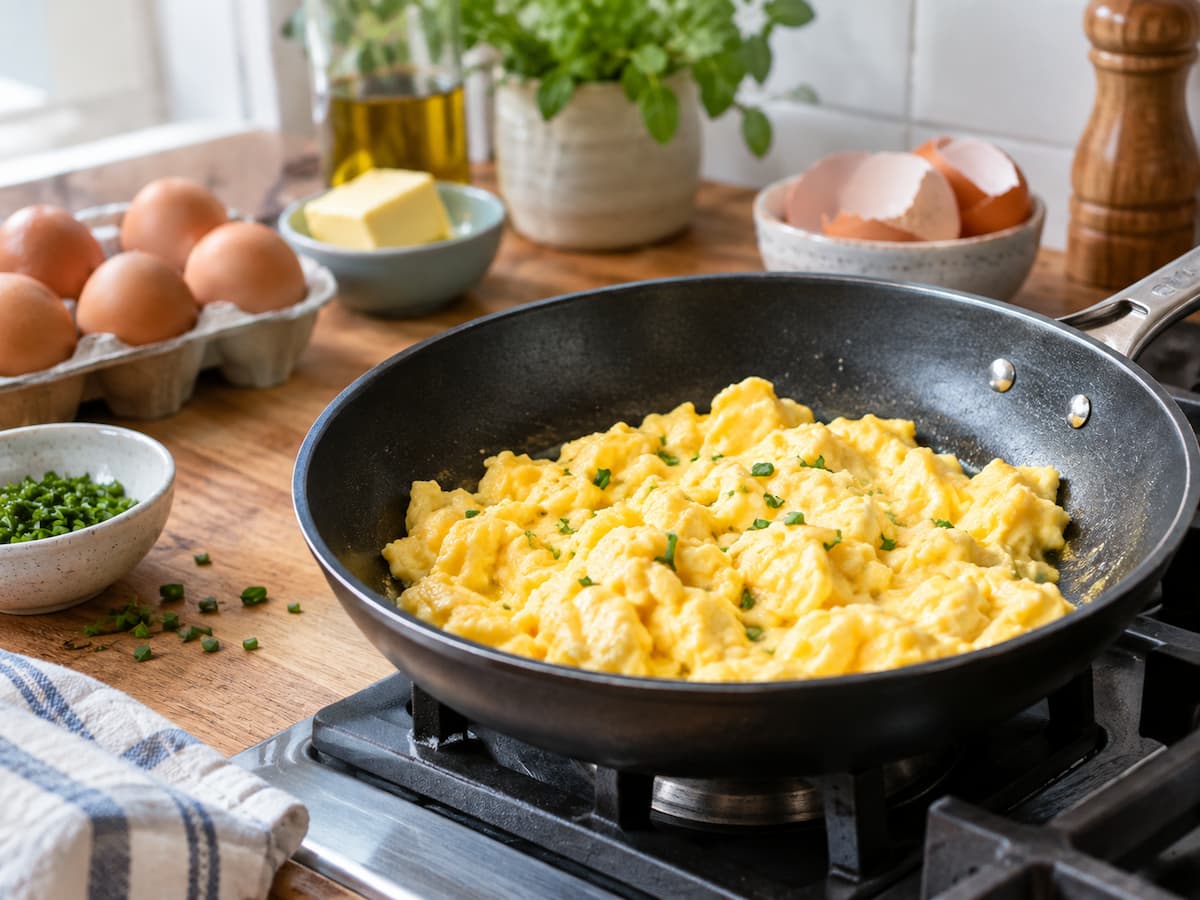
Eggs can go from soft and tender to dry and rubbery surprisingly quickly. The difference is often only a little extra heat or a few extra minutes in the pan. This is especially noticeable with scrambled eggs, but fried, baked, and omelette-style eggs can also become firm and chewy when they are cooked too aggressively.
The good news is that rubbery eggs are usually not caused by one mysterious mistake. Heat, cooking time, pan size, moisture, stirring, and carryover cooking all affect the final texture. Once you understand what each factor does, it becomes much easier to control the result.
Why Eggs Become Rubbery
Eggs contain proteins that change when heated. As those proteins cook, they gradually become firmer. That is what turns a liquid egg into a cooked breakfast. The problem comes when the proteins continue tightening after the texture has already reached the level you want. The egg becomes increasingly firm and can squeeze out some of its moisture. Instead of being tender and soft, it may feel dry, springy, or rubbery.
This is why temperature matters so much. A pan that is much hotter than necessary can cook the outside of the egg quickly while giving you less time to control the centre. Leaving eggs in the pan after they appear finished can create another problem, as they continue cooking from the heat stored in both the egg and the pan.
The goal is not to keep eggs barely cooked. The goal is to stop cooking when the texture is right for the style of egg you are making.
The Biggest Mistake: Cooking Past the Point of Doneness
Many rubbery egg problems begin with a simple habit: waiting until the eggs look completely finished before removing them from the heat. Eggs do not immediately stop cooking when the burner is turned off. A hot pan can continue transferring heat to the eggs, particularly when the eggs are spread across a hot surface. The residual heat can firm them further even after active cooking has stopped.
For scrambled eggs, a useful visual cue is to remove them when they are mostly set but still look slightly moist. They should not be runny, but they also should not look completely dry in the pan.
The exact stopping point depends on the type of eggs and your preferred texture. Someone who likes very soft scrambled eggs will remove them earlier than someone who prefers firmer curds. The important idea is to account for the cooking that happens after the heat is reduced or removed.
Use Moderate Heat for Scrambled Eggs
High heat can make scrambled eggs cook quickly, but speed is not necessarily helpful here. A very hot pan can cause the egg mixture to set almost immediately when it touches the surface. This can create large, firm pieces before you have enough time to shape the curds. If you continue stirring and scraping while the pan remains very hot, the eggs can quickly move from soft to overcooked.
Moderate heat gives you more control. The eggs set gradually, allowing you to move them around the pan and decide when to stop. This does not mean that every scrambled egg recipe needs exactly the same burner setting. Stovetops vary, pans retain heat differently, and the amount of egg in the pan changes how quickly everything cooks. Think of moderate heat as a control strategy rather than a fixed temperature.
If your eggs regularly become dry before you can remove them, try lowering the heat rather than simply shortening the cooking time.
The Pan Size Changes the Result
The amount of egg and the size of the pan need to work together. A small amount of egg in a large, hot skillet can spread into a thin layer. That thin layer has more contact with the hot surface, so it can cook very quickly. By the time you start moving it around, parts of the egg may already be firm.
A very crowded pan creates a different problem. A large quantity of egg may take longer to set, and the cook may keep it over the heat while waiting for the centre to finish. The outer portions can become overcooked before the middle reaches the desired texture.
For a small breakfast portion, a reasonably sized skillet allows you enough room to move the eggs without spreading them into an extremely thin layer. Pan material matters too. Some pans respond quickly when the heat changes, while heavier pans can hold heat for longer. If you are using a pan that stays hot for several minutes after lowering the burner, you may need to reduce the heat earlier than you would with a thinner pan.
Do Not Treat Stirring as a Race
Scrambled eggs need movement, but constant aggressive stirring is not the only way to cook them. The way you move the eggs affects the size of the curds. Gentle folding or sweeping motions can create larger, softer pieces. More frequent movement can produce smaller curds and help distribute heat, but it also makes it easier to break the eggs into very small pieces.
The right approach depends on the texture you want. For larger, tender curds, allow parts of the egg to set before gently moving them toward the centre. For smaller curds, stir more frequently while still paying close attention to the heat. What matters most is not following a particular stirring pattern. It is avoiding the combination of high heat, prolonged cooking, and excessive handling.
Whisk the Eggs Before They Hit the Pan
Whisking helps distribute the yolks and whites throughout the mixture so the eggs cook more evenly. You do not need to beat the eggs until they become extremely foamy. A few thorough strokes are enough to break up the yolks and combine the mixture. If the whites and yolks remain poorly mixed, different parts of the egg can set at slightly different rates. That is not necessarily the main reason eggs become rubbery, but even mixing makes it easier to produce a consistent texture.
This is also a good time to add salt if you normally season your eggs before cooking. The important thing is to mix the seasoning evenly rather than leaving concentrated pockets of salt.
Be Careful With Added Liquid
Milk, cream, water, and other liquids are sometimes added to scrambled eggs to change their texture. But adding more liquid does not automatically make eggs softer. The amount matters, and the liquid has to cook along with the eggs. Too much can make the mixture take longer to set, which may lead you to leave it on the heat longer. The final result can still become firm if the eggs are overcooked.
If you like adding milk or another liquid, use a modest amount and pay attention to the finished texture rather than assuming that more liquid will protect the eggs from overcooking. Butter is different from adding water-based liquid. It is mainly useful for cooking and flavour, while also helping reduce direct sticking between the egg and pan.
Why Butter Can Help, But Cannot Prevent Overcooking
Cooking eggs in butter can make them easier to manage because the fat helps coat the cooking surface and contributes flavour and richness. But butter is not a safeguard against overcooking. If the eggs stay over high heat for too long, they can still become dry and rubbery. A well-buttered pan cannot compensate for excessive cooking. If you use butter, watch both the butter and the eggs. If the butter is browning rapidly before the egg mixture goes into the pan, the pan may already be hotter than necessary for a slow, controlled scramble.
Salt Is Not the Main Cause of Rubbery Eggs
Salt is sometimes blamed for tough or watery eggs, but the bigger practical issue is usually cooking temperature and time. Seasoning preferences vary. Some cooks add salt before cooking, while others add it near the end. Either approach can work for an everyday breakfast. If your eggs consistently turn rubbery, changing when you add salt is unlikely to solve the problem, because the real issue is that the eggs are being cooked too long. Start by examining the heat and the stopping point. Those are usually more useful places to make a change.
Different Egg Styles Need Different Cooking Decisions
The ideal texture is not the same for every breakfast egg.
1. Scrambled Eggs
Scrambled eggs are particularly sensitive to overcooking because the small curds have a large amount of surface area exposed to the pan.
Use moderate heat, move the eggs gently, and remove them while they are still slightly moist. The curds will continue to firm as they sit.
2. Fried Eggs
With fried eggs, the whites and yolks create two different cooking targets.
If you want a runny yolk, the yolk needs less heat exposure than the white. Using excessive heat can make the bottom of the white tough before the top is properly set.
A moderate cooking temperature gives the white more time to cook without forcing the underside to become excessively firm.
For a fully cooked yolk, more cooking time is necessary. In that case, controlling the heat becomes especially useful because you can cook the yolk through without unnecessarily scorching or toughening the white.
3. Omelettes
Omelettes can become rubbery when the egg is left in the skillet until it is completely firm and dry.
Because an omelette is usually one relatively thin layer, it can cook faster than a thick scramble. Once the surface is mostly set and the filling can be added or the omelette folded, there may be little benefit to keeping it over the heat.
4. Baked Eggs
Eggs cooked in the oven can also become firm if the surrounding dish continues to supply heat after the eggs appear to be done.
This is particularly important when eggs are baked with vegetables, sauces, cheese, or other ingredients. The cooking time depends not only on the egg but also on the depth and temperature of the dish.
Visual cues are useful here. If the whites are set but the yolk is still softer than you want, the dish may need additional time. When everything is already firm as it comes out of the oven, carryover cooking can push the texture further.
Cold Eggs Are Not the Main Problem
You may hear advice that eggs must always be brought to room temperature before cooking. That is not necessary for every breakfast preparation. The starting temperature can affect cooking speed, especially in recipes where temperature control is important, but a refrigerated egg can still produce a satisfactory result.
For everyday scrambled eggs, controlling the pan temperature and avoiding overcooking are usually more important than whether the eggs started cold or warm. If you use cold eggs, simply recognise that they may take a little longer to bring up to cooking temperature. Do not compensate by turning the burner excessively high.
Watch for These Signs of Overcooking
You can often identify the cause of rubbery eggs by looking at the finished texture.
If scrambled eggs are:
- Firm and springy rather than tender, they may have stayed on the heat too long.
- Dry with very little visible moisture, they were likely cooked beyond your preferred stopping point.
- Brown around the edges while the centre is still catching up; the pan may have been too hot.
- Cooked in very tiny, dry pieces, they may have been stirred aggressively while cooking too long.
- Still cooking noticeably after being transferred to the plate, carryover heat may have contributed to the final firmness.
These clues are more useful than relying on a single cooking time because stovetops, pans, egg quantities, and personal preferences vary.
What to Do If Your Eggs Are Already Too Firm
Once an egg has been significantly overcooked, you cannot completely reverse the texture. Adding more liquid afterward will not turn firm curds back into freshly cooked soft eggs. You can, however, make the breakfast more pleasant by changing how you use the eggs.
Firm scrambled eggs can be added to toast, a breakfast wrap, a sandwich, or a dish with a moist sauce. If the eggs are only slightly overcooked, adding a little butter or another moist ingredient to the finished dish may improve the eating experience, although it will not undo the protein changes caused by cooking. The better solution is to adjust the next batch: lower the heat, watch the visual cues, and remove the eggs earlier.
A Simple Way to Adjust Your Cooking
- If your eggs are regularly rubbery, change one factor at a time instead of changing everything at once.
- Start with the heat. If you normally cook scrambled eggs over high heat, reduce it to moderate and see how the texture changes.
- Next, change your stopping point. Remove the eggs when they are cooked but still visibly moist rather than waiting for them to look completely dry.
- Then consider the pan. If you are cooking a small amount of egg in a very large skillet, try a smaller pan so the mixture does not spread into a thin layer.
- Finally, look at your stirring. If you are continuously scraping and breaking the eggs apart, use slower movements and allow some curds to form before folding them.
- Making these changes separately helps you understand which part of your routine is causing the problem.
A Practical Example: Soft Scrambled Eggs for One
Suppose you are cooking two or three eggs for breakfast. Whisk them until the yolks and whites are evenly combined. Warm a suitably sized skillet over moderate heat and add your cooking fat. Pour in the eggs and allow them to begin setting before gently moving the mixture. As curds form, fold or sweep them across the pan rather than constantly breaking them apart. Watch the eggs closely because the final stage can happen quickly. When the eggs are mostly set but still look slightly moist, take the skillet away from the heat. Transfer them to a plate rather than leaving them in the hot pan while you prepare toast or coffee. That last step can make a surprisingly noticeable difference. The eggs do not need to look completely dry before they leave the skillet.
Should You Use a Lid?
A lid can change how quickly the top of an egg cooks because trapped heat and steam cook the surface from above. For fried eggs, covering the pan can help set the upper white without requiring the egg to stay in direct contact with the hot skillet for as long. This can be useful when you want the white cooked while keeping the yolk at a softer stage.
For scrambled eggs, however, covering the pan is generally unnecessary because you need to control the curds directly. A lid is therefore a technique choice rather than a universal solution to rubbery eggs.
The Most Important Habit: Cook for Texture, Not the Clock
Cooking times can be useful starting points, but eggs are unusually sensitive to small changes in heat and quantity. Two pans set to the same burner level may not behave the same way. One may be heavier and retain more heat. One batch may contain two eggs while another contains six. A cold pan and a preheated pan will also behave differently.
Instead of relying entirely on a fixed number of minutes, use the egg itself as your guide. Look at how quickly it sets. Notice whether moisture is still visible. Watch the edges for excessive browning. Pay attention to how firm the curds become as you move them. Over time, these cues become more useful than a timer because they tell you what is actually happening in your pan.
The Main Lesson
Rubbery breakfast eggs are usually a heat-and-timing problem rather than an ingredient mystery. Eggs become progressively firmer as their proteins cook, and leaving them over heat after they have reached the texture you want can push them into dry, chewy territory.
For scrambled eggs, moderate heat, a suitable pan, gentle movement, and an earlier stopping point give you more control. For fried, omelette, and baked eggs, the same basic principle applies: cook the egg enough for the result you want, then account for the heat that continues cooking it.
If your eggs are regularly too firm, start with one simple change: take them off the heat while they are cooked but still slightly moist. That small adjustment can prevent the final stage of cooking from taking your breakfast farther than you intended.
FAQs
1. Why do my scrambled eggs become rubbery so quickly?
Eggs can become rubbery when they are exposed to too much heat or remain in the pan after they have already reached the desired texture. High heat makes the change happen especially quickly, so reducing the heat and removing the eggs while they are still slightly moist can help.
2. Should scrambled eggs be completely dry when I remove them from the pan?
No. If you prefer soft or tender scrambled eggs, they can be fully cooked while still looking slightly moist. The eggs will continue to firm as they sit because of residual heat.
3. Does adding milk stop eggs from becoming rubbery?
Not by itself. A small amount of milk can change the texture, but eggs can still become rubbery if they are cooked too long or over high heat. Cooking control matters more than simply adding liquid.
4. Is high heat better for making scrambled eggs quickly?
High heat can make eggs cook faster, but it also reduces the time you have to control their texture. Moderate heat generally gives you more opportunity to stop cooking at the point you prefer.

Olivia Dawson is a food writer and recipe developer focused on creating clear, practical, and family-friendly cooking content. She specializes in approachable recipes made with everyday ingredients and well-explained methods that support confident cooking. Through Recipes With Olivia, Olivia shares thoughtfully crafted meal ideas designed to be reliable, enjoyable, and easy to recreate in everyday kitchens.